Math
-
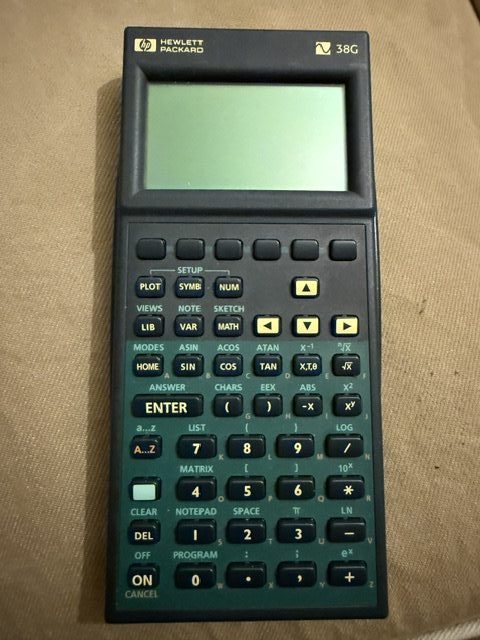
HP38G: Another addition to the calculator collection
I was recently surfing on eBay for an HP calculator and ended up buying 2. One is this HP38G. I didn’t do my research properly of course and only realised after it arrived that this is a traditional style calculator, not the typical HP RPN type I am used to. Apart from that it looks…
-
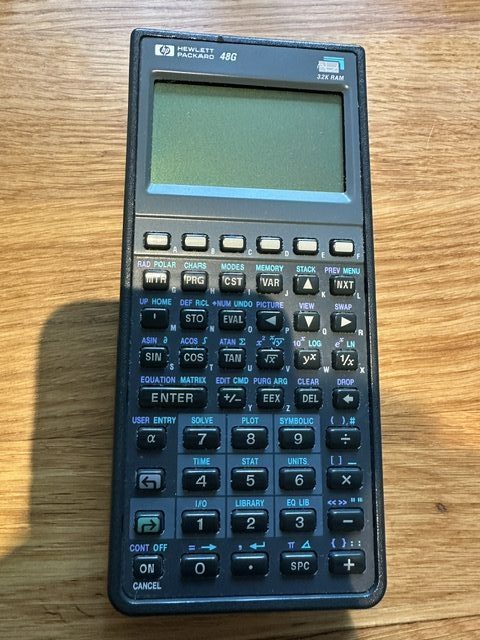
HP48G: A New Addition to the Calculator Collection
A while ago I was browsing Ebay and came across a second hand HP48G which looked quite nice. Price was OK so I decided to buy it. It travelled quite a while coming from the US but it was in working order. The included batteries were apparently old because they died after a month or…
-
Exploring Turtle Graphics: A Random Walk in Python
As part of the 100 Days of Code with Python training we had to plot a random walk using Turtle Graphics. There was a link to this wikipedia page explaining the mathematics and applications of random walks in various fields. I didn’t read all the mathematical details for various dimensions, only the 1d case and…
-
From 100 Days of Code to Ideas for Geometry Projects with Turtle
After having finished the beginner section of 100 Days of Code Python Bootcamp on Udemy I decided to push on and to explore the remaining 85 days of coding as well. A vacation intervened with this but now I managed to continue the lessons and finished days 16-18 which are about Object Oriented Programming. Day…
-
100 Days of Programming Projects: Reflections and Tips after Day 14 and the Beginner Level Section of the Course
Day 14 marks the end of the beginner level. I just finished that and all in all as expected nothing fundamentally new learned so far. Still, I had some refreshers here and there and learned a couple of nice tricks. Most days ended with a guided programming project that used newly learned concepts of that…
-
Understanding the Module Operator: Remainder in Python Explained
In another post I mentioned the module operator and explained it gives the remainder of a division. This description works for positive numbers and 5 % 3 gives 2 which is identical to the remainder but -5 % 3 gives 1 which doesn’t make much sense if it is supposed to be the remainder. If…
-
Mastering Python Basics: Essential Programming Concepts From the First 7 Days of 100 Days of Coding Bootcamp Course on Udemy
The first 14 days are labelled as beginner level. And so far I have certainly not learned any new concepts, it is all about the basics of programming really: variables, conditional statements, loops, functions and the like. Still, most of what I learned so far came from the daily programming projects. During those projects I…
-
Gauss’s Formula for Summing Numbers Continued
In an earlier post I mentioned coming across the reasoning followed by Gauss to prove that the sum of the first n numbers is equal to n(n+1)/2. I started wondering if there is no generalization available for this formula: what is the sum of the whole number m to n, m and n included. Following…
-
Understanding Gauss’s Formula for Summing Numbers
As mentioned in another post I am checking out a 100 days of code python bootcamp on Udemy and following the beginners section to see if it would be useful for my son. On day 5 loops and the range function are discussed. In one lesson Gauss pops up and the story is told how…
-
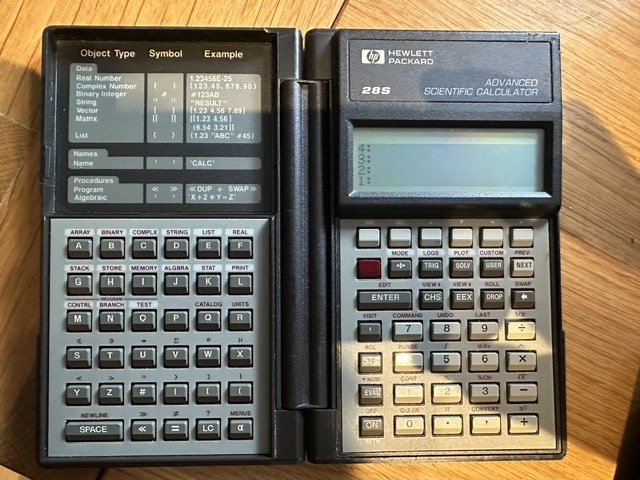
HP-28S Advanced Scientific Calculator
Very long ago, when I was in high school I got my first hp calculator from my dad: a HP-15C. He gave it to me because I had issues with brackets on a standard calculator and with RPN you don’t need brackets. I believe this was in third grade. When things got a bit more…