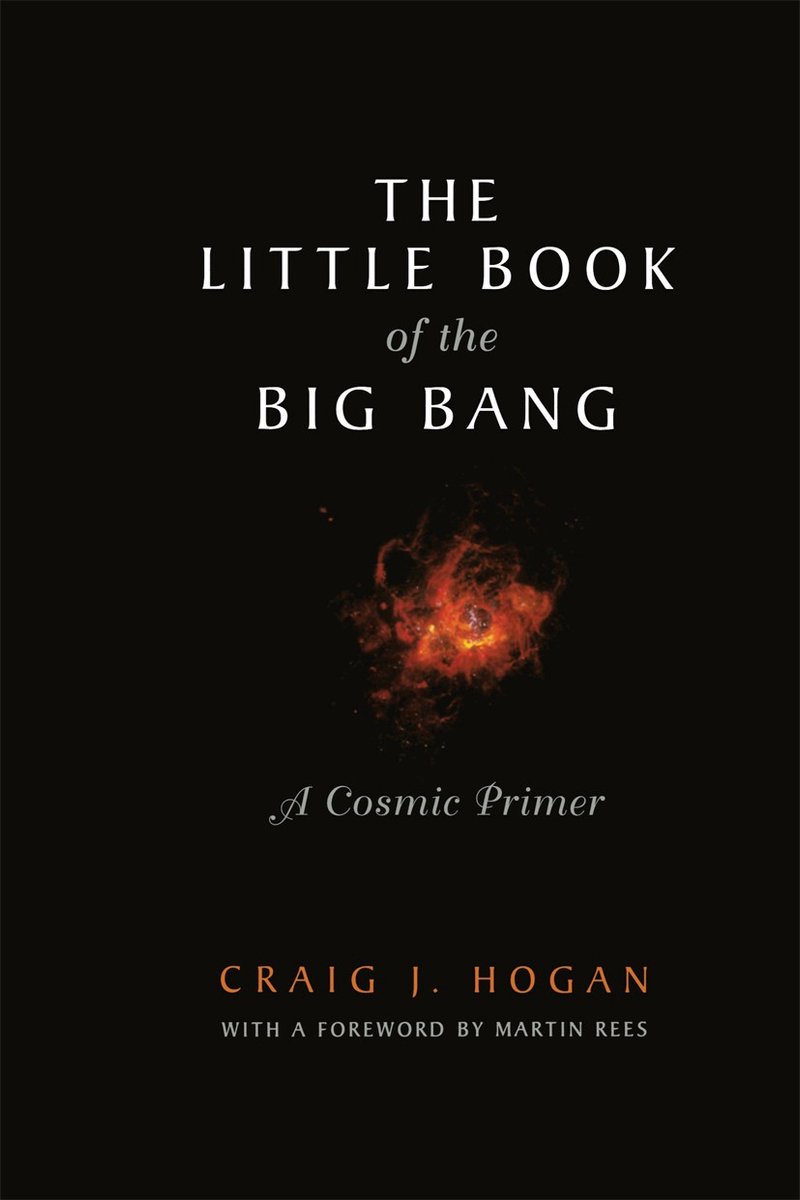
 The title of the book describes the content quite well. In roughly 170 pages the author covers the history of our universe from the Big Bang until today. One reviewer on the back cover goes so far as to claim that Hogan has condensed the story into a pleasurable evening. Although the pages are not too densely packed with text I doubt that most people will fly through it in one evening. I read a chapter here and there over a 2 week period and managed to finish in within 2 weeks without difficulty. Although there are no calculations that the reader has to follow, the book does contain the odd formula in a footnote and some tables and graphs with important data and figures explaining certain concepts and phenomena. It is accessible to the interested layperson but requires a bit of focus to follow the story. The book came out in 1998 and covered scientific developments up to that point. The first 3 chapters cover fundamental physics needed to understand the following chapters. Chapter 4 deals with cosmic expansion and contains some nice figures explaining why everything appears to be moving away from us even though we are not at the center of the unverse. The cosmic background radiation as measured by the COBE satellite is covered in the fifth chapter which includes the link to its spectrum and some fundamental physics to determine the temperature of the background radiation. Variations in the map are linked to the motion of the Earth. The next chapters cover the different types of matter, formation of structure and the role of inflation in that process. Compared to typical popular science books I have read about cosmology this one goes into quite a bit more detail when it comes to explaining where our current picture of the universe comes from. But, as the title says, it is really just a primer and at the end the author lists some references to dive deeper in case of interest. I like the book because I found it a good summary which non the less contained some interesting explanations that I had not encountered before in other popular science books on the subject. It got me motivated to read some more technical text books. One of my professors once said that astrophysics and cosmology were the only branch of physics where the the uncertainties and errors were astronomical. But it is also a branch in which most of physics comes together : relativity, quantum mechanics, atomic, molecular and nuclear physics, thermodynamics and statistical physics, electromagnetism, they all play their part. A good book to get reacquainted and to scratch the surface a little more than usual. Can allegedly be read in one pleasurable evening, within a week should definitely not be a problem, if you so desire.
The Little Book of the Big Bang: A Cosmic Primer, Craig J. Hogan (ISBN 9780387983851; Springer)


Leave a comment