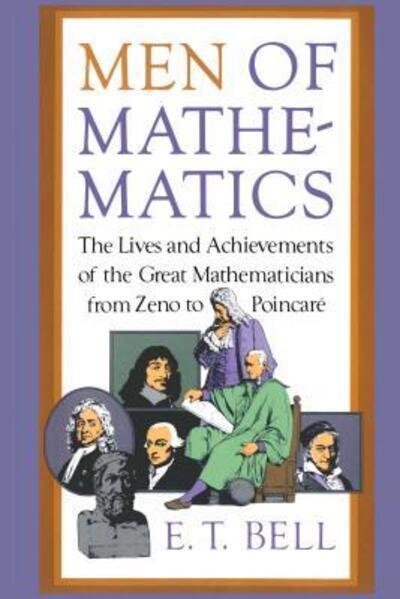
 A ‘classic’ from 1937. The subtitle is ‘The Lives and Achievements of the Great Mathematicians from Zeno to Poincaré’. This is not completely correct as the last chapter is dedicated to Cantor and not to Poincaré. The penultimate chapter is for Poincaré. The first chapter is as usual an introduction and Zeno is tackled in chapter 2. From that point of view the title makes sense again. Technically from Zeno to Cantor would have made more sense as both tackled the problems associated with the infinite. Not that Poincaré had nothing to say about the matter but the mans study was broad and he is commonly most likely more remembered in connection to special relativity for example. Not without reason Poincaré is introduced in the book as the last universalist. The subtitle describes the gist of the book. The book covers a number of great mathematicians summarising their main achievements together with some important facts about their personal lives. Already long ago I had to learn theorems of many of the mathematicians in this book and I found it interesting to get a glimpse of the men behind the mathematician. It will be no surprise that only 1 woman made it into the book. Not because of inherent male superiority in mathematics but because until fairly recently women were not even allowed to study at university. The brief glimpse at the lives of the mathematicians highlights how social circumstances sometimes influenced their careers and poverty, revolutionary politics or lack of medical cures cut their lives and careers short. One thread in the history is the increased importance of mathematical rigour, first introduced by Gauss and continued by his predecessors. The other is the continuous struggle of the mathematics with the concepts of zero, infinity and continuity from the time of Zeno until the present. Anyone interested in history can read the book but the mathematical part probably benefits from some prior knowledge in mathematics. The discussion of the mathematics is very general and without the use of formulas but if you know some of the work or theory the mathematicians work on it will help in appreciation what they achieved. Still, anyone interested in the history of mathematics can/should read this book.
Men of Mathematics, Eric Temple Bell (ISBN 978-0-6716-2818-5, Simon & Schuster)
 Response 418
Leave a comment