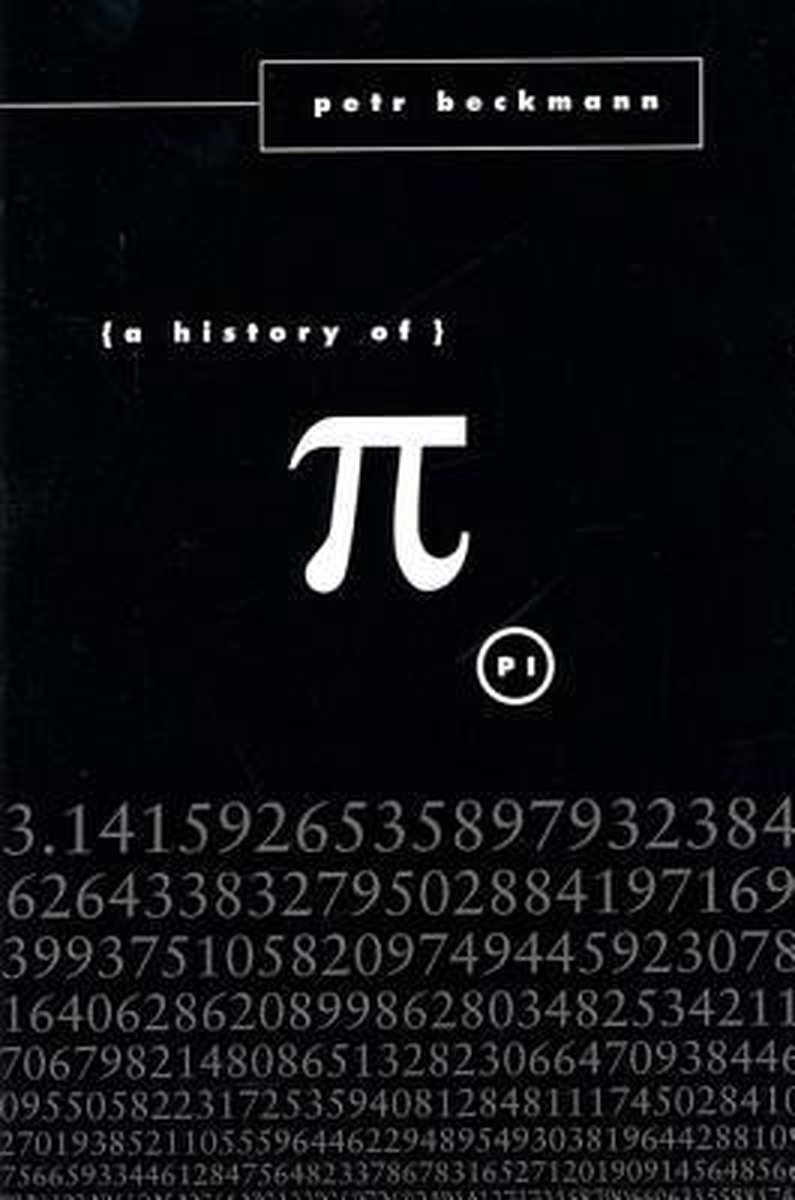
 (a history of) Pi first came out in 1970 and the author was a professor of electrical engineering at the University of Colorado. Beckmann fled Czechoslovakia at the age of 14 to escape the Nazis. In the introduction Beckmann states that he could write his own personal history of pi without having to worry about canonical viewpoints held by historians and mathematicians. The book is therefor not a rigorous historical and/or mathematical account of the history of pi. Rather it is an eclectic trip through time making stopping at societies where the knowledge of advanced. It starts with several pre Hellenic cultures like the Babylonians and elsewhere where mathematics was invented. We meet the Greeks and their breakthrough work on mathematical rigor with Euclid and the polygon approach to determine pi by Archimedes. We pass the Romans and Middle Ages to arrive in the renaissance and continue to the 20th century. The various mathematical methods to determine pi are described including formulas and derivations of results. For the non mathematical reader these sections are probably too technical and for professional mathematicians they are probably too trivial. Beckmann encourages both to simply skip ahead. Fans of tyrants will not like this book much as Beckmann uses every opportunity to ventilate his dislike for totalitarian and military regimes when we encounter for example Spartans, Romans and the wholly inquisition. Besides being stupid these societies didn’t contribute anything to the advancement of our knowledge of pi and they get a lot of negative publicity for it in this book. Beckmann’s outspokenness is sometimes funny and sometimes tiresome. The book is a strange mix of mathematics, history and politics but because it is short (200 pages) it remains enjoyable and interesting until the end. Only the last chapter on how computers have been used to calculate pi is a little outdated. It is only 10 pages or so and you can actually skip it without missing anything important in this history of pi. What I like most is how it illustrates the connection between the evolution of mathematics and associated available techniques with our knowledge of pi, going from the Greeks and geometry with polygons to trigonometry combined with calculus and series expansions.
A History of Pi, Petr Beckmann (ISBN 978-0312381851, St Martin’s Press)
 Response 418
Leave a comment