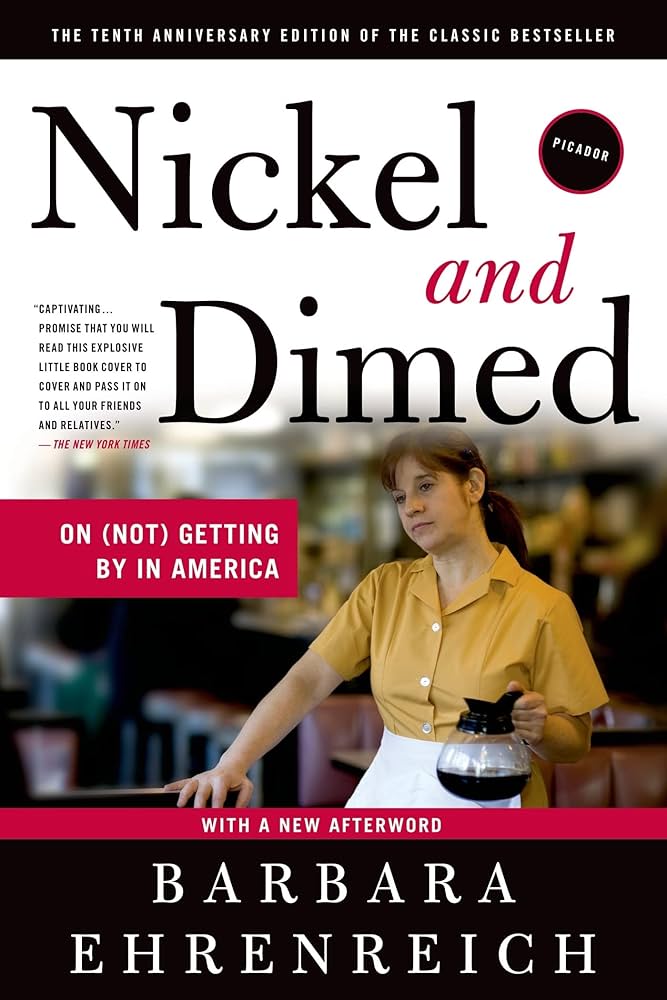
 I finally read this book last week after it had been sitting on a shelf for a decade. Ehrenreich is a journalist who got asked by a publisher to write a piece about the living conditions of low wage workers in America. She decided to find out by getting such a job herself and mimic having to live from such a salary for a few months. She worked in 3 different locations doing jobs as a waitress, cleaning personel and finally working for Wal Mart. When Ehrenreich originally did her investigative journalism in 2000 the economy was strong and she had no trouble finding low wage jobs. The main problem was that it was impossible to find decent housing on such a low wage and 2 incomes were needed to survive, either by doing 2 jobs yourself or by 2 people working to have a combined income to finance decent housing. Ehrenreich further stressed that even so her situation was relatively easy compared to real life workers as she was educated, physically fit and healthy and she had a car and no kids to support. Even working 2 jobs left her income so low that she was vulnerable to financial set backs caused by for example illness or injury and with working 7 days a week doing physically demanding work this was bound to happen sooner or later. I found this an interesting read and from the prose and style it is obvious that Ehrenreich is a professional writer and went through the 200 pages in a few days. I bought the 2011 version with a new afterword by the author reviewing how the situation of the working poor had evolved. And the plight of the working poor had deteriorated severely as the economy was in a downturn after the financial crisis in 2008 and by 2011 even low wage jobs were hard to get. The book created quite some controversy and while it hit the best seller lists and even became mandatory reading at some universities it also attracted predictable criticism from true believers in unrestricted capitalism, charging that the book was a Marxist rant that had all the economic facts wrong. Even today the reviews on GoodReads show the same dichotomy. As a European such criticism towards the Marxist ideology of the author is mildly amusing at best but mostly just hypocritical. While the jobs are neither financially or emotionally worthwhile for the working poor, leaving them vulnerable to the whim of their employer without unions, welfare and affordable health insurance, the people benefiting from the existence of such jobs are the classes above that get access to cheap unessential services like house cleaning, dining out and Wal Mart shopping. Of course I putting it very black and white and simplistic terms and one can wonder what would happen to all these people if their wages became too high to support the business model, meaning the customers are not willing to pay the price anymore. To me this is a compelling argument for a society and its citizens to pay up for decent welfare, health insurance and affordable housing for the working poor. A lot can be said and written and disagreed about with respect to this book but at least I hope we can allow it to serve as a mirror to confront us with our obsession with success stories of people making the American dream come true, never ever asking who paid the price or made it possible in the shadow.
Nickel and Dimed. On (not) getting by in America, Barbara Ehrenreich (ISBN 9780805063899, Henry Holt & Company)
 Response 418
Leave a comment