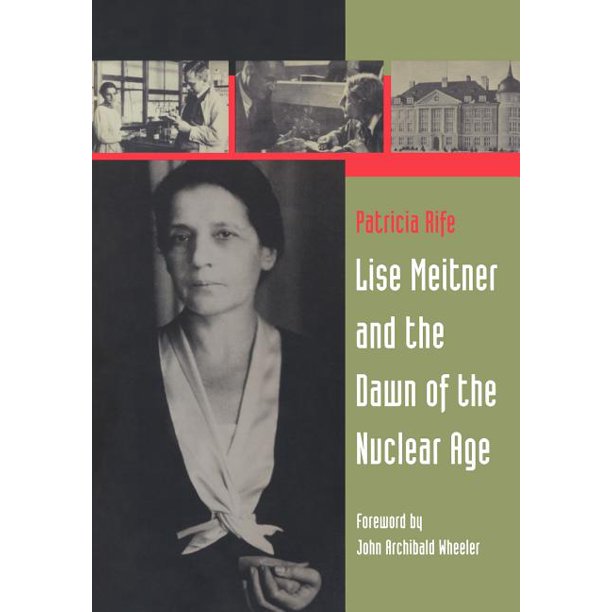
 A very nice biography about one of the ‘forgotten’ women of science. I came across a reference to this book somewhere and decided to read it as part of my ‘atomic’ theme. It also fits nicely into a series of books I am reading about women scientists. I had read the excellent ‘The making of the atomic bomb’ of Richard Rhodes before and this also covers the discovery of fission. In that discovery Lise Meitner played an important role. It is surprising that so few people know the name Lise Meitner. I studied physics myself and had not really heard of her. Considering the breadth and importance of her work this is inexplicable. The book is well written and gives a good high level appreciation of the importance of Lise Meitner as a physicist. In a time where we lack enough scientists this book offers at least one fresh alternative ‘role model’. As a biography it also serves as a history of society in general and reading this book made me grateful again not to have lived in Lise Meitner’s days. She was born in 1978 in Vienna and young women were only allowed to go to school until the age of 14 and even that schooling was biased towards the future role of women as wives. Lise had a gift for science and mathematics and her parents supported her in her ambition to get a higher education and become a physicist. This took a lot of effort, perseverance and time. After 14 Lise studied some subject to be able to teach and then was fortunate to see the laws in Austria change just in time to allow her to get her ‘high school’ degree and go to university where she was taught by Ludwig Bolzmann. After getting her doctorate in 1906 she could not get an academic position and decided to go for a year to Berlin and study with Max Planck. In Berlin she was also not allowed an official position at first, having to do unpaid research in some basement so as not to disturb the men on the upper floors. 1 year became 30 years working in close collaboration with Otto Hahn on radioactivity until in 1938 she had to flee for the Nazis and ended up in Sweden. During the period in Berlin she and Hahn had discovered the fission of uranium but not recognised it as such. Only after Meitner was already in Sweden did the chemical analysis by Hahn finally establish that one of the radioactive decay species was Barium. Lise Meitner then gave the physical explanation with the uranium splitting into 2 almost equally sized small nuclei. Because of the Nazi reign and Meitner being of Jewish descent Hahn could not acknowledge that Meitner had contributed to the discovery and when Hahn received the Nobel prize for chemistry after the war this rewriting of scientific history was not corrected and over the years the memory of Lise Meitner has faded. This book does a good job bringing her contributions back to the forefront so that we remember her and give her the place in scientific history she deserves.
Lise Meitner and the Dawn of the Nuclear Age, Patricia Rife (ISBN 978-0817637323, Birkhäuser)
 Response 418
Leave a comment