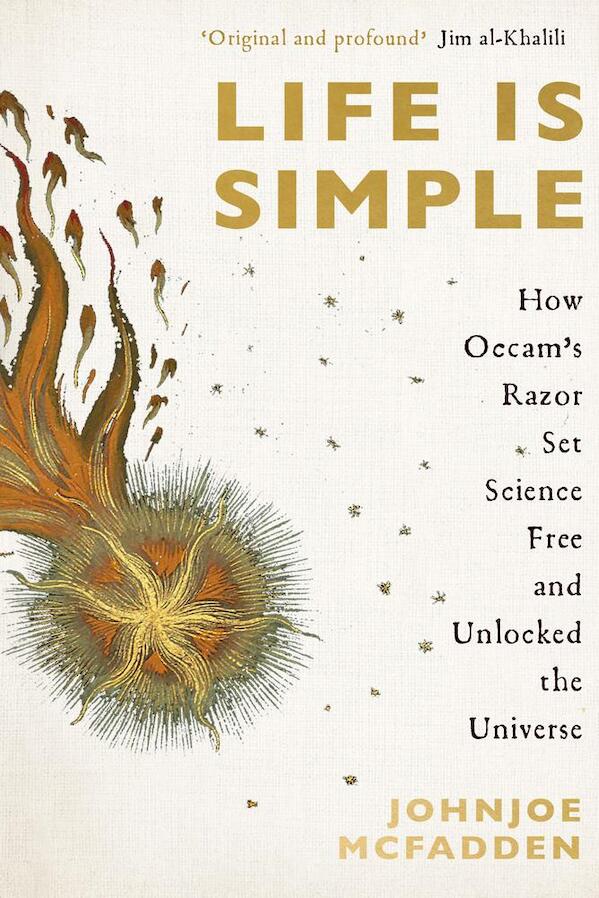
 I started reading this book at the end of August and only just finished it yesterday. My wife bought it at Dominicanen in Maastricht during our visit there in July and read it on vacation. She asked me to read it as well so we could exchange thoughts about it. The book is a history of science but one looking at how Occam’s razor influenced the evolution of scientific thought and theories through time. This approach makes it quite different from more traditional approaches. The main focus is on how the demand for simplicity lead to new theories in various fields. As a result the scope is quite wide but details on specific theories are few. The first third of the book deals with scientific thought in the Middle Ages and introduces the figure of William of Occam and his ideas. It then describes how his ideas finally lead to a ‘strict’ separation between science and religion. The next blocks of the book then look at how Occam’s razor was applied in certain fields. First comes the move from the geocentric universe of Ptolemy to the heliocentric one of Keppler and Galileo. The next section illustrates the use of Occam’s razor in biology and specifically the theory of evolution. The final chapters are about the role of simplicity in physics and cosmology. This focus of the impact of the demand for simplicity in explanations is what make this book worth reading. Do not expect a lot of detail about specific theories however. For details about the various fields the references at the back will probably be useful. Depending on your personal preferences you can pick the ones that match your fields of interest. The book is also permeated by the author’s personal views about science. Depending on your own tastes you may like this or not. Personally I find the nominalism advocated in the book too limiting and I believe the theories we invent to describe the world around us do not only exists in our mind but have some reality in the real world as well. Of course you can argue that our current theories are no complete description of the world and so cannot be real but maybe some aspects of those theories are real. I do agree we are never able to prove a theory to be 100% surely true but stating like the author does that you also cannot prove a theory false I can’t agree with. On the subject of physics and quantum mechanics in particular there were a few sentences that I think are debatable but as it is all discussed with very little detail it is hard to know if it is just due to ambiguity in the interpretation of what is written or that there maybe a more fundamental difference in opinion. The book made me think again about my own scientific and philosophical views so I can conclude that the time reading the 300 pages was well spent.
Life Is Simple, JohnJoe McFadden (ISBN 978-1-529-36495-8, Basic Books)
 Response 418
Leave a comment