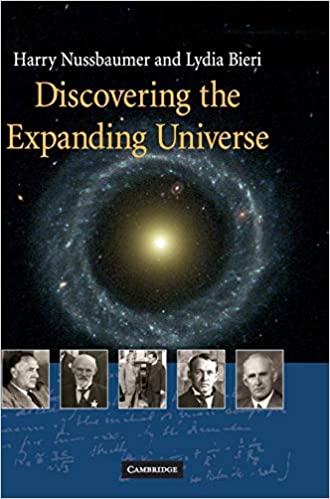
 This book from Cambridge University Press was first published in 2009. As the title suggests this is a history of how the expanding universe was discovered. Although all mathematics are banned to an appendix you should not expect a typical popular science book. The 187 pages spread over 18 short chapters deal with the most important theoretical and observational publications that finally lead to the view that we live in an expanding universe. The chapters discuss the implications of data and/or models presented in these key publications and how they finally lead to a physical view of an expanding universe. Although there is no mathematics involved the discussion is at times quite technical and having a bit of background knowledge will certainly help to grasp certain arguments. Still, it is not necessary to understand all the technical details to enjoy this book and it is not the objective of the book to go into all the technical and mathematical details. The focus of the book is on how our world view evolved from a static Copernican spherical heliocentric view to the one we hold today through advancements in astronomy and cosmology. And within this evolution the scope is limited to key steps taken in the 19th and 20th century. After an introduction the journey really starts with nebulae and how people struggled for a long time to understand their true nature. Near the end of the 18th century Herschel pointed a big telescope to the skies discovering hundreds of new nebulae and resolving them into individual stars. He amassed a great number of observations and started mapping out structure of our Milky Way. That lead to discussions of the size of the Milky Way and the universe, our place in the Milky Way and whether nebulae were actually island universes on their own far away or part of our Milky Way. As time went on spectroscopy and photography were added to observations and red shifts were discovered leading in the end to the observational discovery of the Hubble constant. In parallel Einstein published a cosmological model based on general relativity. A constant source of confusion in all this was the uncertainty of the measured distances to starts and galaxies and as long as the data was not accurate enough different competing models could be proposed that fit the observations of the time. This makes it quite remarkable that Georges Lemaitre came out up with essentially the correct theoretical model of an expanding universe in 1927 roughly 40 years before measurements of the cosmic background radiation finally confirmed it. I enjoyed reading this book and can recommend it to anyone interested in the history of astronomy and cosmology (but not as an introduction to these subjects).
Discovering The Expanding Universe, Harry Nussbaumer and Lydia Bieri (ISBN 978-0-521-51484-2, CUP)
 Response 418
Leave a comment